By Madeleine Waterfield.
Our three girls were born and raised in a village just outside of Bath in an area of outstanding natural beauty. After a couple of years of thoroughly enjoying home education, we made the momentous decision to take a year out and travel around Australia. The idea began to ferment when it occurred to me that, even though I had grown up in Australia, I had no idea what a coral reef looked like. The girls needed no persuasion when I showed them photos, and my husband, a seasoned overland traveller, also loved the idea.
We began researching and viewing photos of incredible places in that vast land. We had no doubt that an experience like this was going to be an adventure of a lifetime and richly rewarding, not only from an educational perspective. On our kitchen wall we stuck an enormous hand-drawn map of Australia which we covered with photos, paintings, sketches and projects on National Parks, geological wonders and World Heritage Sites we planned to see. The wall started to look very colourful and inviting with the very endearing sketches children do, in this case of kangaroos and kookaburras, waxy and exotic wildflowers, waterfalls, Aboriginal art and some colourful fish and coral we might encounter further north. I included a sepia photo of an Australian swagman from the early 1900s.
Swagmen carried everything they owned, travelling on foot as they looked for seasonal work. My Nanna had lived in a small town in rural New South Wales, where a swagman would come and chop wood or do odd jobs for her in exchange for lunch, food to go and a ‘twist of tea’.
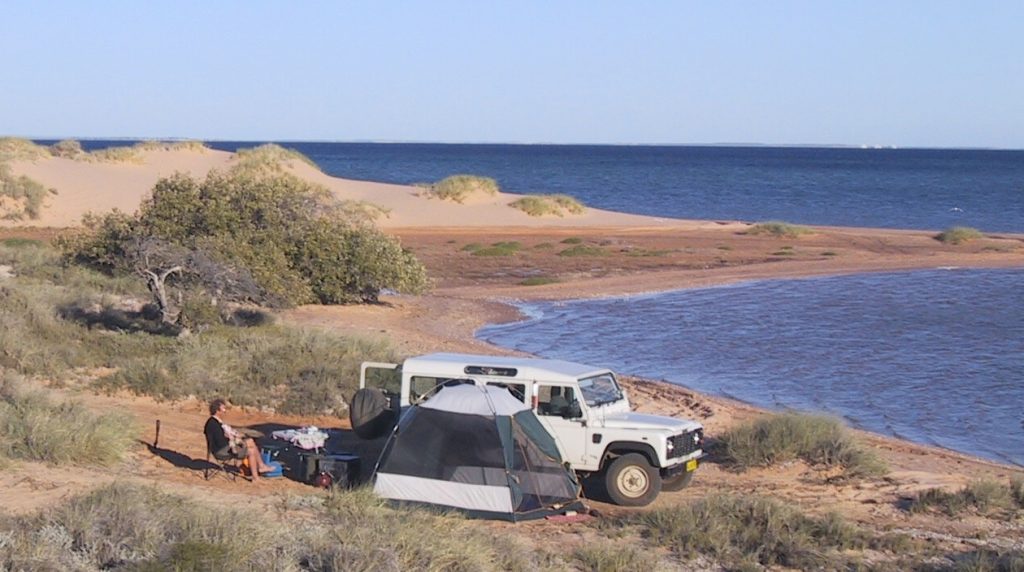
We knew that on our travels we would be immersed in nature, overawed by wild, rugged, diverse landscapes and no matter where we would park up, as the sun starts to go down, we won’t have to say ‘Girls, it’s time to go home’ as the land, the car, the tent and all that could be packed, stacked, rolled or stowed would be home. Life was going to be simple.
The plane touched down in Sydney, and we walked out to the deafening drone of cicadas, raucous and colourful birds, bold and bright wildflowers, eucalyptus leaves and flowers perfuming the air, and felt enveloped by the Australian heat. We soon found a suitable vehicle which we kitted out ourselves. Once the girls had chosen their favourite toys and packed their swimmers and diaries, we set off in a clockwise direction staying south until the hurricanes and storms of the “Big Wet” in the north subsided.
We found ourselves attracted to wilderness; some of our highlights included travelling through deserts and dirt tracks of rutted red earth, contrasting sharply with clear blue skies. The grasslands were the habitat for endless termite mounds that looked like upright stones we loved to visit in England. One desert had bright yellow sand and a ‘forest’ of stone ‘pinnacles’ that were also bright yellow. In another desert we scrambled up the slope of a meteorite crater. It looked like it hadn’t been disturbed in the 300,000 years it had been there. At the highest point, we watched a large, full moon rise in the dusky purple sky above the opposite side, and we looked at the craters on its luminous surface as we stood on the rim of an ancient one.
We explored dramatic gorges with bands of coloured sedimentary layers of sandstone providing steps for majestic waterfalls cascading before our eyes into waterways surrounded by lush tropical plants. The rugged and wild coasts had us mesmerised as waves crashed on rocks and pristine beaches gave the girls endless opportunities to collect shells, bones, feathers, rocks, gumnuts and other treasures which we eventually presented in an exhibition in Bath, when we returned. This became a thoroughly enjoyable home ed project allowing us to relive our magical experiences and share them with others.
The far north was a tropical wonder where we took more rugged and remote journeys, this time with a family we’d made friends with along the way, on dusty tracks, challenging river crossings that were inhabited by crocodiles, and saw more geological wonders like tiered waterfalls of the Kimberley and the striped beehive domes of Purnululu. We were so fortunate to see Aboriginal rock art that had been protected and preserved for 40 thousand years or more. We learnt a lot about Aboriginal culture and that some communities were the oldest continuous living cultures in the world.
The most spectacular sea experiences for us during this unforgettable year were the coral reefs. The absolute wonder of them made our eyes shine. Wading in and making sure we didn’t tread on the fat black sea slugs, as big as cucumbers, we put our snorkels on and immersed ourselves in ‘another world’. I held hands with the girls, and we delighted in the abundant, colourful and curious sea life; brilliant coral, neon-patterned fish, varieties of seaweed in what seemed like a swaying flower and vegetable garden. We saw turtles, octopus and even one or two reef sharks that glided by so fast, totally uninterested in us but still making our hearts stop. We finally experienced the rich beauty of coral.
One quiet night, we sat under the stars, our bare feet on the dry, sandy soil. We had driven to a remote rest area, pitched the tent amongst the gum trees and had a barbeque. The sun had gone down in a spectacular display of changing colours, and the children were sleeping. The night was still and laden with the scent of eucalyptus. I looked up at the stars shining in that vast, deep sky and felt a feeling that I wished I could feel all the time – calm, grounded, in awe of nature; connected. I was part of everything around me and felt fulfilled. Those stars have been around for billions of years and the land around me also felt ancient. Even though time seemed to stand still, I was reminded that our time on earth is fleeting.
The rich and colourful beauty of Australia, and indeed the natural beauty of our entire planet Earth, inspire us all to cherish nature and love life. As indigenous people remind us, the land provides for us, heals us and teaches us. We have a duty to protect the land, and our freedoms for future generations.
For more information, please visit us here.
